Performances
FEATURING: Paweł Sakowicz, Iza Szostak, Marta Ziółek, Kuba Falk
The FRSK Foundation — www.frsk.pl — is an independent cultural organization based in Warsaw, founded and directed by Artur Kos. At the intersection of contemporary art, performance, education, and international cultural cooperation, FRSK develops artistic, research, and outreach projects in collaboration with cultural institutions and creative communities in Poland and abroad.
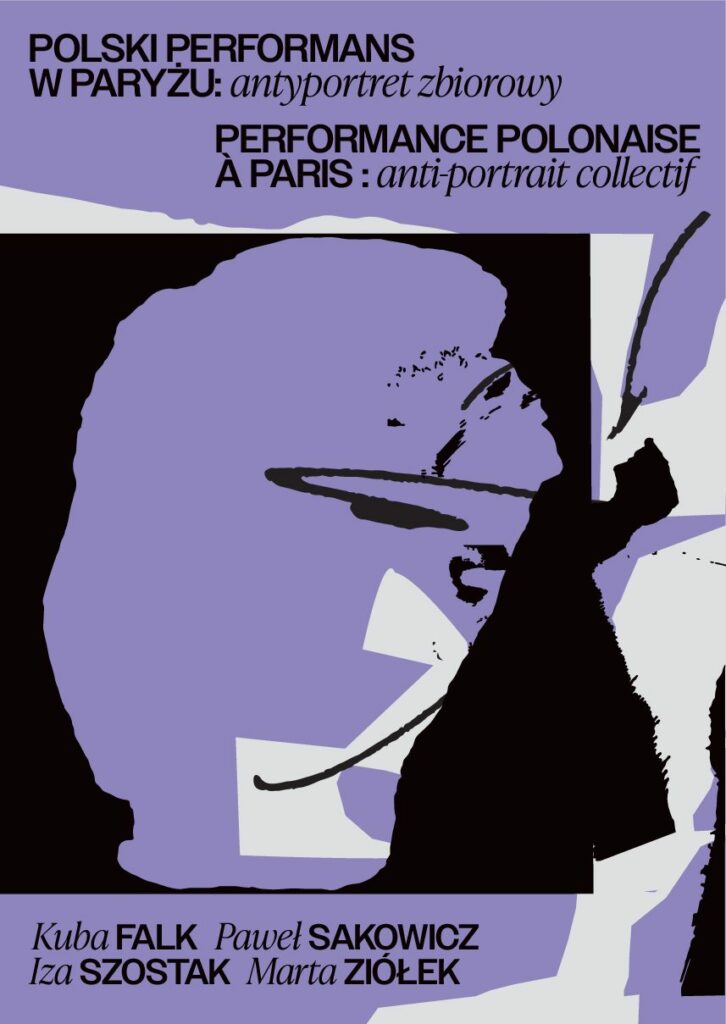
Polish Performance in Paris: Collective Anti-Portrait (Polish Performance in Paris: Collective Anti-Portrait) is the second edition of FRSK’s long-term program dedicated to presenting contemporary Polish performance art in various European cities. Following Polish Performance in Porto: Identity – Embodiment – Process (Polish Performance in Porto: Identity – Corporeality – Process), future editions will continue this exploration in new territories and around new curatorial themes.
Presented as part of FRASQ 2026, this project highlights the diversity of contemporary Polish performance art through the works of artists with unique approaches, drawing from choreography, performance, and interdisciplinary practices. The starting point for this edition is the idea of a collective anti-portrait: an encounter between artistic approaches, experiences, and individual working methods. Developed in collaboration with Le Générateur, the program creates a space for dialogue between the Polish and French performance scenes, while fostering artistic exchanges and the development of lasting relationships among artists, institutions, and audiences.
Project co-funded by the Minister of Culture and National Heritage of the Republic of Poland through the Fund for the Promotion of Culture.
Kuba Falk, Children of Saturn
Kuba Falk is a performance and interdisciplinary artist working across performance, video, sound, photography, installation, and text. At the center of his practice is the body as a site where memory, identity, personal histories, and collective narratives intersect. His works explore queer genealogies, the relationship between humans and technology, ecology, and mechanisms of representation. He creates performative situations that he describes as “bodytales”—narratives that unfold through presence, connection, and interaction with audiences. His works have been presented in New York, Berlin, Chicago, Porto, Prague, and Kyiv, among other cities. Regardless of medium, he remains interested in the ways the body stores experience and constructs alternative forms of community and memory.
Children of Saturn explores aging, care, and intergenerational transmission through the figure of a collective antiportrait. The work stems from personal experiences of caregiving and reflections on the visibility of queer elders within contemporary culture. Falk investigates the tension between presence and image, memory and archive, the living body and its digital trace. The figure of Saturn prompts a reflection on inheritance, dependency, and transformation, while leaving open the question of how successive generations carry, reinterpret, and live with the experiences of those who came before them.
Paweł Sakowicz, Katarakta
Paweł Sakowicz is a choreographer and dancer whose practice focuses on movement as a physical, historical, and cultural phenomenon. His projects often emerge from long-term research processes involving dance history, choreographic practices, and the transmission of knowledge through the body. He is interested in mechanisms of repetition, transformation, and embodied memory, as well as in the tensions between discipline and improvisation. His performances and choreographic works straddle the boundaries of contemporary dance, performance, theater, and the visual arts. His work has been presented at numerous festivals and venues across Europe and the United States. A recurring aspect of his practice is the observation of movement as a process of continuous change and negotiation with its surroundings.
Katarakta explores a choreographic investigation of movement in a constant state of transformation. The work draws inspiration both from cataracts—a condition causing blurred vision—and from waterfalls as a force of continuous motion and change. Sakowicz is interested in moments when perception loses stability and attention shifts between images, sensations, and impulses. The choreography is built around curiosity as a method of practice and around movement that remains open to unpredictability, changing directions, and the continuous reconfiguration of its own internal logic.
Iza Szostak, MINGLE
Iza Szostak is a choreographer, performer, and artist whose work operates at the intersection of choreography, performance, visual arts, and new technologies. Her practice explores bodily transformation, memory embedded in movement, and the relationship between individual and collective experience. Her projects frequently combine choreographic methods with field research, archival work, participatory practices, and immersive technologies, including virtual and augmented reality. She is a co-founder of Centrum w Ruchu, a Warsaw-based space dedicated to experimental choreographic practices. Her works have been presented in theaters, galleries, and art institutions in Poland and internationally. She is particularly interested in situations in which the body becomes a vessel for memory, relationships, and processes of constant transformation.
MINGLE explores the body as a shared and constantly shifting space. Meanings, memories, gestures, and relationships accumulate within it, altering its contours and modes of being. Particular attention is given to experiences of intimacy and care, especially those emerging through relationships with children, where the boundaries of the body become fluid and open to negotiation. The work reflects on presence, dependency, and mutual influence, approaching embodiment as something that takes shape through encounters, proximity, and acts of coexistence.
Marta Ziółek, GAZE. Unruly Pleasure
Marta Ziółek is a choreographer, performer, and director working across dance, performance, visual arts, and educational practices. Her artistic work explores the relationships between corporeality, pleasure, eroticism, affect, and visual culture. She is interested in the ways the body participates in the construction of social relations, the negotiation of norms, and the creation of new forms of collectivity. Her projects frequently employ choreography as a tool for emancipation, sensitivity, and critical reflection on mechanisms of visibility. Marta Ziółek’s works have been presented in Poland as well as at international contemporary art institutions. In recent years, she has developed projects exploring the relationships between eroticism, pleasure, visibility, and bodily agency, examining their social, affective, and political dimensions.
GAZE. Unruly Pleasure focuses on the gaze as a bodily, affective, and social experience. Marta Ziółek examines mechanisms of visibility and the ways in which looking shapes relationships between pleasure, desire, and power. The performer approaches the gaze as an active force capable of producing images of the body while simultaneously challenging established modes of perception. At the center of the work lies a question about agency in relation to cultural and social mechanisms of representation, as well as the potential of eroticism understood as a practice of relationality, intense feeling, and emancipation.